

Understanding CPP and EI Payroll Deductions: Rates, Maximums, and Exemptions for 2026
Calculating payroll deductions accurately is essential for compliance and employee trust. Two major components in Canadian payroll are Canada Pension Plan (CPP) contributions and Employment Insurance (EI) premiums. These rates and maximums change annually, so staying updated is crucial for employers and payroll professionals.
What’s New for CPP in 2024 and Beyond?
Starting January 1, 2024, employers must deduct a second additional CPP contributions (CPP2) on earnings above the annual maximum pensionable earnings. This is part of the CPP enhancement, designed to strengthen retirement benefits for Canadians.
Each year, the Canada Revenue Agency (CRA) sets:
- Maximum pensionable earnings
- Basic exemption amount
- Contribution rate for employees and employers
CPP Contribution Rates and Maximums (2010–2026)
|
Year |
Max Pensionable Earnings |
Basic Exemption |
Contribution Rate (%) |
Max Employee Contribution |
Max Employer Contribution |
|---|---|---|---|---|---|
|
2026 |
$74,600 |
$3,500 |
5.95 |
$4,230.45 |
$4,230.45 |
|
2025 |
$71,300 |
$3,500 |
5.95 |
$4,034.10 |
$4,034.10 |
|
2024 |
$68,500 |
$3,500 |
5.95 |
$3,867.50 |
$3,867.50 |
|
2023 |
$66,600 |
$3,500 |
5.95 |
$3,754.45 |
$3,754.45 |
CPP Contribution Rate Trend (2010–2026)

Key Insight: CPP contribution rates have gradually increased from 4.95% in 2010 to 5.95% in 2024, reflecting the CPP enhancement initiative.
CPP Basic Exemption by Pay Period
The basic exemption amount remains $3,500 annually, but here’s how it breaks down by pay period:
|
Pay Period |
Exemption Amount |
|---|---|
|
Monthly |
$291.66 |
|
Bi-weekly |
$134.61 |
|
Weekly |
$67.30 |
Employment Insurance (EI) Premiums
EI premiums are calculated based on maximum insurable earnings and the annual EI rate. These differ for Federal and Quebec employees.
Federal EI Premium Rates (2010–2026)
|
Year |
Max Insurable Earnings |
EI Rate (%) |
Max Employee Premium |
|---|---|---|---|
|
2026 |
$68,900 |
1.63 |
$1,123.07 |
|
2025 |
$65,700 |
1.64 |
$1,077.48 |
|
2024 |
$63,200 |
1.66 |
$1,049.12 |
EI Premium Rate Trend (2010–2026)
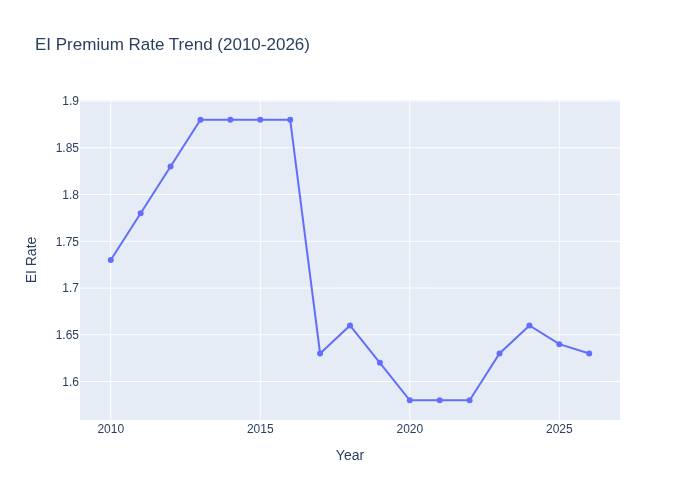
Observation: EI rates have fluctuated slightly, but the maximum insurable earnings have steadily increased, impacting total premiums.
Step-by-Step Guide: How to Calculate CPP and EI Deductions
CPP Calculation Example
- Employee annual salary: $70,000
- Basic exemption: $3,500
- Contributory earnings: $70,000 – $3,500 = $66,500
- Contribution rate (2024): 5.95%
- Employee CPP deduction: $66,500 × 0.0595 = $3,957.75
- Employer matches: $3,957.75
EI Calculation Example
- Employee annual salary: $70,000
- Max insurable earnings (2024): $63,200
- EI rate: 1.66%
- Employee EI deduction: $63,200 × 0.0166 = $1,049.12
- Employer contribution: $1,049.12 × 1.4 = $1,468.77
Why These Changes Matter
- Employers: Accurate deductions prevent compliance issues and penalties.
- Employees: Understanding contributions helps with financial planning.
- Payroll Professionals: Staying updated ensures smooth operations and trust.
Need Expert Help with Payroll Compliance?
At Achen Henderson, we specialize in payroll management, tax compliance, and accounting solutions for Canadian businesses. Contact us today to streamline your payroll and accounting processes!